
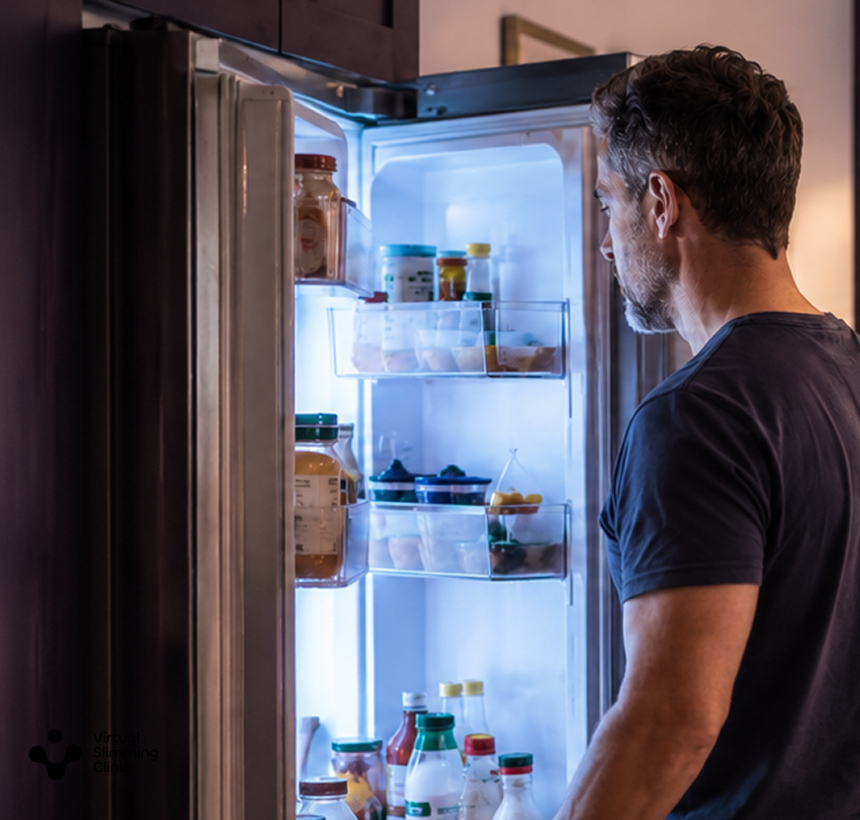


You meant to eat less today. By the evening you were hungry, fed up, and eating anyway.
If that sounds familiar, here is something worth knowing. Feeling hungry all the time is not a sign that you are weak or greedy. Hunger is controlled by your body, not by your character. And your body is very good at getting what it wants.
Here is what the research actually says.
Your body decides when you feel hungry
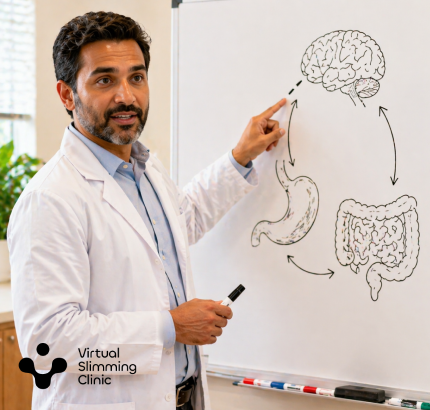
Hunger is not really a decision. It is a signal your body sends to your brain.
Two hormones do most of the talking:
Ghrelin is made mostly in your stomach. It rises before meals and tells your brain you are hungry.
Leptin comes from your fat tissue. It tells your brain you have enough energy stored, so you can ease off.
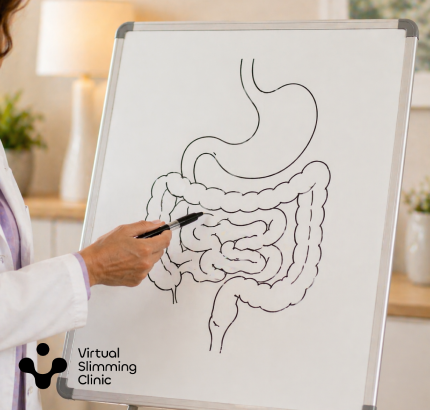
Other signals from your gut join in after you eat, helping you feel satisfied and finish the meal. Your brain listens to all of them at once and decides how hungry you feel. You do not control this any more than you control feeling tired or thirsty.
Why eating less makes you hungrier
This is the part most diet advice leaves out.
When you eat less, your body notices quickly. Hunger signals go up. Fullness signals go down. Your body is not punishing you — it thinks food has become scarce and is trying to protect you.
The important finding is how long this lasts. In a study published in the New England Journal of Medicine, researchers followed people for a full year after they lost weight on a low-calorie diet. The changes in their appetite hormones were still there twelve months later, and so was the increased hunger (Sumithran et al., 2011). The body did not simply adjust and move on.
So when you feel like you are fighting your own body, you are right. You are. And it does not tire out the way you do.
Some people really are hungrier than others
If you have ever watched someone eat the same meal as you and stay full for hours longer, you were not imagining it.
Researchers at King's College London studied over 1,000 people, using continuous glucose monitors to track blood sugar after meals. They found that some people experience a sharp dip in blood sugar two to four hours after eating, well after the initial rise (Berry et al., 2021). NICE
The people with bigger dips — the researchers called them "big dippers" — felt 9% hungrier, waited about half an hour less before their next meal, and ate around 312 more calories across the day than people who ate exactly the same food. NICE
Age, body weight and BMI made no difference to who was a big dipper. It came down to individual differences in how each person's body handles food. NICE
In other words: two people can eat an identical breakfast and have genuinely different experiences of hunger by mid-morning. That is biology, not discipline.
So is it just willpower?
No. And this matters, because many people carry real shame about it.
Willpower is real, but it runs out. You spend it at work, with your children, in traffic. Your hunger hormones do not run out. They work all day, every day, without getting tired.
That is not a fair fight. If hunger were only about trying harder, the people who try hardest would always succeed. That is not what we see.
NICE, which sets clinical standards for the NHS, now treats overweight and obesity as long-term conditions that need ongoing support (NICE, 2025) — not as short-term problems to be solved with effort.
Other things that make hunger worse
Alongside hormones, a few everyday factors have a real effect:
- Poor sleep raises hunger signals and cravings the next day
- Stress drives eating that has little to do with physical hunger
- Meals low in protein or fibre empty quickly and leave you looking for more sooner
- Eating fast or distracted means fullness signals arrive after you have already finished
None of these are character flaws either. They are inputs to the same system.
When to speak to someone
Constant hunger is usually about hormones, food and lifestyle. Occasionally it points to something else — including thyroid problems, poorly controlled blood sugar, or a side effect of medication.
Worth a conversation with a clinician if your hunger:
- Came on suddenly or changed sharply
- Continues even after balanced, protein-rich meals
- Comes with unusual thirst, tiredness, or unexplained weight change
What actually helps
Once you see hunger as biology, the question changes. It stops being "why can't I try harder?" and becomes "how do I work with a body built to resist this?"
That is the purpose of proper weight management. A clinical assessment looks at your health, your history and what is actually driving your hunger — then builds a plan around you, rather than asking you to fight yourself. NICE recommends exactly this kind of tailored, individual approach (NICE, 2025).
The short version
You are not always hungry because you are greedy or weak. You are hungry because your body is doing its job — and in some people, it does that job more loudly than in others.
Understanding that is where things start to change.
Want to understand what is driving your hunger? Start your consultation and speak with our clinical team.
Common questions
Why am I still hungry after a big meal?
Feeling full depends on hormone signals, not just how much is in your stomach. If those signals are weak, or your blood sugar dips afterwards, you can eat plenty and still not feel satisfied (Berry et al., 2021).
Is everyone's hunger the same?
No. King's College London researchers found large differences between people eating identical meals — and those differences were not explained by age, weight or BMI (Berry et al., 2021). NICE
Do you get hungrier when you lose weight?
Usually, yes. Appetite hormones shift towards hunger as weight comes down, and research shows this can persist for at least a year (Sumithran et al., 2011). It is normal, and it is not a sign you are failing.
Could constant hunger be a medical problem?
It can be linked to sleep, stress, some medicines, or a health condition such as thyroid or blood sugar problems. If it is a marked change for you, speak to a clinician rather than managing it alone.
References
Berry, S., Valdes, A., Wyatt, P. and Spector, T. (2021) 'Postprandial glycaemic dips predict appetite and energy intake in healthy individuals', Nature Metabolism. Available at: https://www.nature.com/articles/s42255-021-00383-x (Accessed: 22 July 2026).
National Institute for Health and Care Excellence (2025) Overweight and obesity management. NICE guideline NG246. Published 14 January 2025, last updated 8 January 2026. Available at: https://www.nice.org.uk/guidance/ng246 (Accessed: 22 July 2026).
Sumithran, P., Prendergast, L.A., Delbridge, E., Purcell, K., Shulkes, A., Kriketos, A. and Proietto, J. (2011) 'Long-term persistence of hormonal adaptations to weight loss', New England Journal of Medicine, 365(17), pp. 1597–1604. doi: 10.1056/NEJMoa1105816.


.jpg)
























































































.avif)