



If you've looked into weight-loss treatment recently, you'll have noticed the landscape has changed — and not just in the medicines available. The way reputable services assess whether treatment is right for you has become considerably more rigorous, and that's very much a good thing. Behind that shift sits a clear expectation from the regulators: that no one is prescribed medication for their weight on the strength of a quick form and a self-reported figure.
This piece explains what a proper assessment now involves, why measures like body fat percentage and waist circumference tell you more than the scale, and why the verification step you'll encounter with a careful provider exists to protect you — not to slow you down.
Why assessment matters more than the number on the scale
For a long time, weight was treated as the whole story — step on the scale, read the verdict. But weight alone, and the BMI figure derived from it, was never designed to tell an individual what their actual health risk is. So, is BMI accurate? As a quick population-level screen, it's useful enough. As a verdict on any one person's health, it's surprisingly limited — and understanding why is the key to understanding what a proper assessment adds.
BMI began life in the 1830s as a way of describing populations, not individuals. It's still used because it's quick and cheap at scale — but on its own it can't tell muscle from fat, can't see where fat is stored, and doesn't adjust well for ethnicity, age or sex (National Institute for Health and Care Excellence, 2025). That's why a meaningful number of people sitting at a "normal" BMI are in fact carrying a level of body fat that does carry risk (Romero-Corral et al., 2008) — and why others are flagged by BMI when they're perfectly healthy.
A proper assessment looks wider than that single number. And increasingly, that's not just good practice — it's what's expected of any responsible provider.
What the regulators now expect
This is the part worth understanding, because it explains a lot about why a careful service asks more of you than a quick questionnaire.
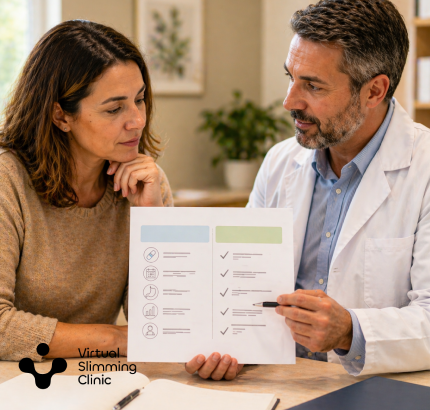
Guidance from the pharmacy regulator is explicit: a prescriber must not base a prescribing decision on a questionnaire alone. They're expected to use a form of consultation that allows genuine two-way communication, and to independently verify the information you provide — including your weight, height and BMI — rather than simply take it at face value (General Pharmaceutical Council, 2025). Where that can't be done safely, the guidance is clear that you should be directed to another care provider for proper assessment rather than prescribed to regardless (General Pharmaceutical Council, 2025).
The principle behind all of this is patient safety. These are powerful medicines, and prescribing them appropriately depends on an accurate picture of the person in front of the clinician. Verification isn't bureaucracy — it's the difference between treatment that's genuinely suited to you and treatment based on a guess.
It's also why you may have seen recent warnings about how these medicines are promoted. The regulators have made clear that treatment for weight should be approached through proper clinical assessment, not marketed like a consumer product (Medicines and Healthcare products Regulatory Agency, 2026) — a position we wholeheartedly agree with.
The measures that give a fuller picture
So if not the scale alone, what does a fuller assessment actually look at? A few simple measures, read together, tell a far richer story.
Body fat percentage is the proportion of your weight that's fat rather than muscle, bone and water. Two people of identical weight can have very different percentages — and very different health profiles. Commonly cited reference ranges put a healthy band at roughly 14–24% for men and 21–31% for women, rising gently with age. These are orientation ranges, not targets to chase, and exact figures vary between sources.
Waist circumference and waist-to-height ratio are among the most useful things that can be measured simply. They're a strong signal of the visceral fat around the organs that drives cardiometabolic risk (Després and Lemieux, 2006). The rule of thumb worth remembering: keep your waist to less than half your height (Ashwell, Gunn and Gibson, 2012).
Your wider health picture — medical history, existing conditions, medications, allergies, family history — matters just as much. Some conditions make treatment suitable at a lower BMI; others make particular treatments unwise (National Institute for Health and Care Excellence, 2025). None of that is visible on a scale.
Read together, by a clinician, these build the picture that decides whether treatment is appropriate and, if so, which.
How we approach assessment at VSC
We've built our assessment around exactly this principle: that a sound decision needs an accurate, verified picture — not a self-reported number.
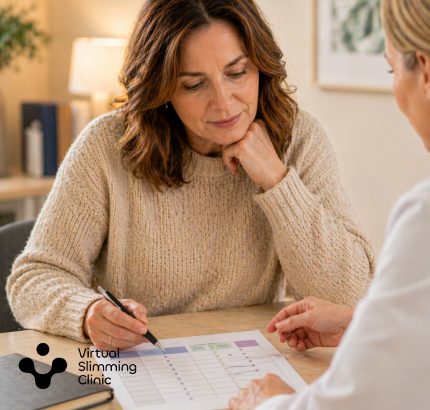
That means your assessment goes well beyond a tick-box form. We take a full medical history, your existing conditions and allergies, and the wider context of your health. Your weight and BMI are independently verified rather than simply accepted, through more than one means, and your assessment is reviewed by a clinician before any decision is made. We also re-verify at regular intervals through your treatment, not just at the start.
We're deliberately not going to detail every mechanism here — but the principle is simple: we verify properly, we involve a clinician, and we'd rather do the assessment thoroughly than quickly. It's what keeps treatment appropriately safe for you, and it's what lets your clinician make the right call for your circumstances rather than a generic one.
When it's worth starting that conversation
If you've been wondering whether treatment might be appropriate for you — particularly if previous approaches haven't worked, or if there's type 2 diabetes or heart disease in your family — the most useful next step isn't another guess at the scale. It's a proper assessment that reads your full picture.
Whenever you're ready, our clinical team is here to take you through it carefully.
Frequently asked questions
Is BMI accurate?
Not on its own. BMI is a useful population-level screen, but for an individual it can't distinguish muscle from fat or see where fat is stored — so it's best read alongside body fat percentage, waist measurement and your wider health.
Why do I need a proper assessment for weight-loss treatment?
Because these are powerful prescription medicines, and prescribing them safely depends on an accurate, verified picture of your health — not a self-reported figure. Guidance for prescribers requires genuine clinical assessment and independent verification, for your protection.
What's the difference between BMI and body fat percentage?
BMI uses only height and weight, so it can't tell muscle from fat or see where fat is stored. Body fat percentage measures the proportion of your weight that's actually fat — a more individual picture, best read alongside waist measurement and your wider health.
Why is my weight verified rather than just accepted?
Because an accurate starting measurement is what a safe prescribing decision depends on. Verifying it protects you from treatment based on an inaccurate figure, and it's what responsible, guidance-aligned care involves.
What's a healthy waist measurement?
A useful rule of thumb is to keep your waist to less than half your height. It's a simple home measure that signals cardiometabolic risk more reliably than weight alone.
Can I be treated if my BMI is in the normal range?
Sometimes — certain conditions make treatment appropriate at a lower BMI. That's exactly the kind of judgement a proper clinical assessment exists to make, rather than a single threshold.
References:
Ashwell, M., Gunn, P. and Gibson, S. (2012) 'Waist-to-height ratio is a better screening tool than waist circumference and BMI for adult cardiometabolic risk factors: systematic review and meta-analysis', Obesity Reviews, 13(3), pp. 275–286.
Després, J.-P. and Lemieux, I. (2006) 'Abdominal obesity and metabolic syndrome', Nature, 444(7121), pp. 881–887.
General Pharmaceutical Council (2025) Providing weight management services: FAQs. Available at: https://www.pharmacyregulation.org/pharmacies/standards-and-guidance-registered-pharmacies/providing-weight-management-services-faqs (Accessed: 24 June 2026).
Medicines and Healthcare products Regulatory Agency (2026) Warning on promoting newly licensed prescription-only medicines and unlicensed medicines for weight management. Available at: https://www.gov.uk/government/news/warning-on-promoting-newly-licensed-prescription-only-medicines-and-unlicensed-medicines-for-weight-management (Accessed: 24 June 2026).
National Institute for Health and Care Excellence (2025) Overweight and obesity management. NICE guideline NG246. Available at: https://www.nice.org.uk/guidance/ng246 (Accessed: 24 June 2026).
Romero-Corral, A., Somers, V.K., Sierra-Johnson, J., Thomas, R.J., Collazo-Clavell, M.L., Korinek, J., Allison, T.G., Batsis, J.A., Sert-Kuniyoshi, F.H. and Lopez-Jimenez, F. (2008) 'Accuracy of body mass index in diagnosing obesity in the adult general population', International Journal of Obesity, 32(6), pp. 959–966.

.jpg)


.jpg)


























































































.avif)