


When people talk about losing weight, they usually mean losing fat. But your body doesn't work quite like that.
When you lose weight, you lose a mix of things: fat, water, and some muscle. That last one worries a lot of people — and it's a fair thing to worry about. Muscle is what gets you up the stairs, carries the shopping, keeps your blood sugar steady and keeps you steady on your feet as you get older.
The good news is that muscle loss isn't something that just happens to you. It's something you can influence, quite a lot, through a few simple habits. Here's what the evidence says.
Key takeaways
- Losing some muscle alongside fat is normal in any kind of weight loss — through diet, exercise, or a prescribed weight management plan.
- Research suggests roughly 15–25% of the weight lost during calorie restriction comes from lean tissue rather than fat.
- Strength and physical function often hold steady even when muscle size changes slightly.
- Two things protect muscle more than anything else: eating enough protein and resistance training.
- You can build muscle while losing weight. Most people notice a difference within about 6–8 weeks of consistent training.
- Losing weight gradually, rather than crashing, gives your muscle a much better chance.
Why you lose muscle when you lose weight
Your body runs on energy. When you eat less than you burn, your body has to make up the difference from its own stores.
Fat is the main store it draws on — that's the whole point. But your body doesn't only burn fat. It also breaks down a small amount of muscle protein for energy, and it quietly "downsizes" muscle it doesn't think it needs. A smaller body needs less muscle to move it around, so from your body's point of view, letting some go is efficient.
Researchers have measured this. In studies of people losing weight through calorie restriction, somewhere around 15–25% of the total weight lost tends to be lean tissue rather than fat.¹ So if the scales go down by 10kg, perhaps 2kg of that isn't fat.
This is not a sign something has gone wrong. It's simply how weight loss works — and it happens whether you lose weight through a diet, through exercise, or with medical support.
Does weight management medication change this?
This is one of the most common questions we're asked, and it deserves a straight answer.
Prescribed weight management treatments reduce your overall body weight — not your fat alone. So yes, some lean tissue is lost too. Reviews of the research so far suggest the proportion of muscle lost is broadly in line with what you'd expect from any comparable amount of weight loss.
There is an important nuance, though. Because medically supported weight loss can be larger overall, the absolute amount of muscle lost can be larger too — even if the percentage looks similar. That's exactly why protein and strength training matter more, not less, when you're losing weight with clinical support.
Some researchers also argue that part of this change is an adaptive response rather than a harmful one: a smaller body genuinely needs less muscle, and lean tissue shrinking in proportion is not the same as muscle wasting away.⁴ The research is still developing, and it's an area clinicians are watching closely.
Your strength matters more than the number
Here's something reassuring that often gets lost in the headlines.
Muscle size and muscle function are not the same thing. In many studies, people losing weight keep their grip strength, their walking speed and their ability to get out of a chair unaided — even when scans show a small drop in muscle mass.
There's a reason for that. Losing excess weight makes your muscles more sensitive to insulin, meaning they take up and use blood sugar more efficiently.² You're also carrying less load, so everyday movement gets easier. In practice, most people feel stronger, not weaker, as they lose weight — provided they're eating and moving sensibly.
So don't judge your progress by muscle mass alone. Ask yourself: can I climb the stairs more easily? Can I carry more? Do I get up off the floor without thinking about it? Those answers tell you more than a body composition reading.
Can you build muscle while losing weight?
Yes. It's harder than building muscle while eating plenty, but it's absolutely possible — and it's especially achievable if you haven't done much resistance training before.
With consistent strength work and enough protein, most people see measurable improvements in strength and muscle within around 6 to 8 weeks. Not years. Weeks.
Five ways to protect your muscle
1. Eat enough protein — and spread it out
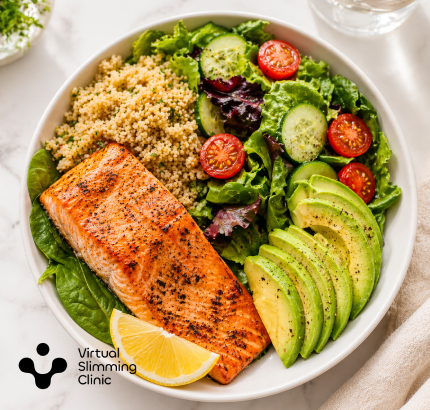
Protein is what muscle is built from. Without enough of it, your body has no raw material to repair and rebuild with.
Research on preserving muscle during weight loss points to around 1.2–1.5g of protein per kilogram of body weight per day.¹ For someone weighing 80kg, that's roughly 96–120g a day.
The practical bit: spread it across 3–4 meals rather than loading it all into dinner. Your body can only use so much at once. Aim for a decent source of protein at every meal — eggs, Greek yoghurt, chicken, fish, lean mince, beans, lentils, tofu, cottage cheese, or a protein shake if that's easier.
If your appetite is much smaller than it used to be, protein should be the thing you eat first on the plate, not last.
2. Do resistance training at least twice a week
This is the single most powerful thing you can do.
When you work a muscle against resistance, you create tension and a small amount of controlled stress. Your body responds by repairing and strengthening that muscle. Without that signal, your body has no reason to hold onto muscle it isn't using.
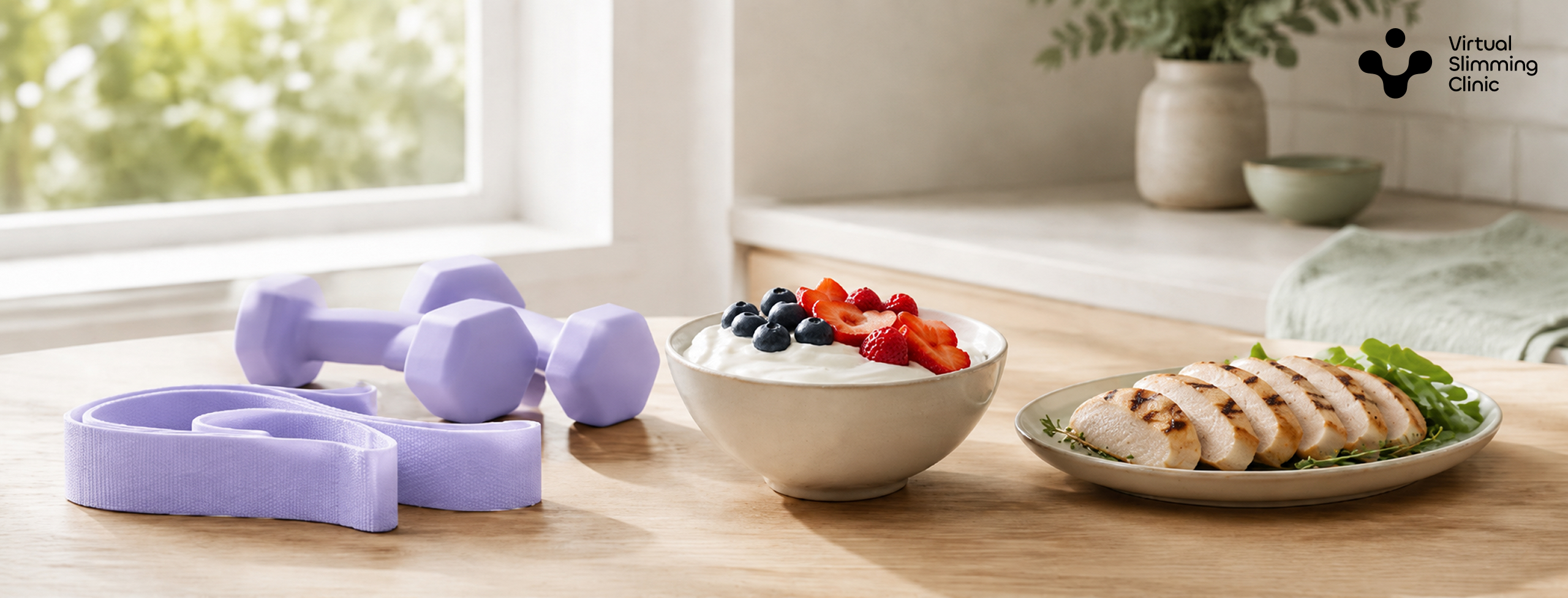
Aim for two to three sessions a week, covering your whole body. Resistance training doesn't have to mean a gym or heavy weights. Bodyweight moves (squats, press-ups against a wall, sit-to-stands from a chair), resistance bands, or a couple of dumbbells at home all count. What matters is that the last few repetitions feel genuinely hard.
3. Lose weight at a steady pace
Very rapid weight loss and very low calorie intakes take a bigger toll on lean tissue.¹ Gradual, sustained weight loss protects muscle far better — and it's also more likely to last.
If your weight is dropping much faster than expected, that's worth raising with your clinical team rather than celebrating.
4. Keep moving day to day
Resistance training is the priority, but general movement helps too. Walking, cycling, gardening, swimming — all of it supports your overall health, appetite regulation and mood, and none of it works against your muscle.
5. Don't neglect the basics
Sleep is when a lot of muscle repair happens. Hydration affects performance and how you feel. And when you're eating less overall, it's easier to fall short on vitamins and minerals, which support muscle and bone health — so aim for variety, plenty of vegetables, and enough calcium and vitamin D. If you're unsure, ask your clinician.
When to speak to your clinical team
Get in touch if you notice:
- Everyday tasks feeling harder rather than easier
- Weight dropping much faster than you expected
- Struggling to eat enough protein because of a very reduced appetite
- Ongoing tiredness, weakness or dizziness
-
None of these are things to push through quietly. They're things to review.
How we approach this at Virtual Slimming Clinic
Muscle preservation isn't an optional extra in a weight management programme. It's part of doing it properly.
Your consultation begins with a full review of your medical history, so any treatment plan is built around your health rather than a template. Our clinicians then review your progress at clinical checkpoints — not just your weight, but how you're eating, how you're moving, and how you're feeling. Where nutrition or activity needs attention, that's addressed as part of your plan.
Treatment, where it's appropriate, is dispensed through our GPhC-registered pharmacy partner. But medication is one part of a structured programme, never the whole of it. The habits in this article are what make the difference over years, not weeks.
Frequently asked questions
Is muscle loss from weight loss reversible? Yes. Muscle responds to being used. With regular resistance training and enough protein, most people rebuild strength and muscle, and often notice a difference within 6–8 weeks.
How do I stop losing muscle while losing weight? Two things do most of the work: resistance training at least twice a week, and eating around 1.2–1.5g of protein per kilogram of body weight daily, spread across 3–4 meals.
Will I lose more muscle if I lose weight quickly? Generally, yes. Faster, more severe calorie restriction is harder on lean tissue than gradual weight loss. A steadier pace protects muscle better and tends to be more sustainable.
Does losing weight with medical support cause more muscle loss than dieting? The proportion of lean tissue lost appears broadly similar to other forms of weight loss. Because overall weight loss can be greater, the absolute amount can be larger — which is why protein and strength training are emphasised throughout a clinically supervised programme.
Do I need a gym to protect my muscle? No. Bodyweight exercises, resistance bands and light dumbbells at home are all effective, as long as the effort is genuinely challenging by the end of each set.
Should I be tracking anything other than weight? Yes — and it's often more useful. Track what you can do: how many sit-to-stands, how heavy a bag you can carry comfortably, how far you can walk. Function is a better guide to muscle health than the scales.
This article is for general information and does not replace personalised medical advice. If you have questions about your own health or treatment, speak to your clinician.
References
- Cava, E., et al. "Preserving Healthy Muscle During Weight Loss," Advances in Nutrition, vol. 8, issue 3, 2017:511–519. https://pmc.ncbi.nlm.nih.gov/articles/PMC5421125/
- Ceasovschih, A., et al. "Glucagon-like Peptide-1 Receptor Agonists and Muscle Mass Effects," Pharmacological Research, vol. 220, 2025:107927. https://www.sciencedirect.com/science/article/pii/S1043661825003524
- Krzysztofik, M., et al. "Maximising Muscle Hypertrophy: A Systematic Review of Advanced Resistance Training Techniques and Methods," International Journal of Environmental Research and Public Health, vol. 16, issue 24, 2019:4897. https://pmc.ncbi.nlm.nih.gov/articles/PMC6950543/
- Linge, J., et al. "Muscle Mass and Glucagon-like Peptide-1 Receptor Agonists: Adaptive or Maladaptive Responses to Weight Loss?", Circulation, vol. 150, no. 16, 2024:1288–1298. https://www.ahajournals.org/doi/10.1161/CIRCULATIONAHA.124.067676
- Mozaffarian, D., et al. "Nutritional Priorities to Support GLP-1 Therapy for Obesity: A Joint Advisory from the American College of Lifestyle Medicine, the American Society for Nutrition, the Obesity Medicine Association, and the Obesity Society," American Journal of Lifestyle Medicine, 2025. https://journals.sagepub.com/doi/10.1177/15598276251344827

.jpg)


.jpg)












































































.avif)